A Surprise Inspection Without the Surprise Visit
A Surprise Inspection Without the Surprise Visit
A guest checks in, walks the unit, and texts you four words: THE HOME IS FILTHY. They want a refund. That message is the first hard data you have about the clean, and by the time it arrives, the cleaner is gone, the guest is furious, and the review is already forming in their head.
This is the quiet failure at the center of every remote turnover operation. You built a process: dispatch, assignments, completion confirmations. And you still can't answer the only question that matters, was it actually clean?, until someone standing in the room answers it for you.
That blind spot shows up everywhere operators talk about turnovers: the missed corner, the clean that was “done” but not verified, the guest complaint that arrives too late to fix without a refund or a redo. Speed helps, but speed alone doesn’t tell you whether the job met standard. If you can’t see the unit, you’re always reacting after the fact.
The real issue isn’t effort. Most teams already have enough hustle to keep jobs moving. The issue is evidence. Without a way to verify quality on-site, every clean is still a trust exercise. And trust is a shaky system when the guest is the first person to inspect the result.
Every miss has the same shape
Read the failures back to back and they rhyme. Each one is a quality fact learned too late, from the guest, because no one was on-site to measure the clean while it happened.
A common example looks like this: the team gets a guest complaint about a floor, someone scrambles to redo the unit, and the fix starts only after the guest has already checked in. By then, the refund conversation has started and the review has already been colored by the failure.
Late cleans create a different kind of miss. When a cleaner arrives too close to check-in, there’s no margin to verify the job before the next guest walks in. Even a solid cleaner can get squeezed by timing, travel, or a previous turnover that ran long. The result is the same: no inspection window, no buffer, no confidence.
Then there’s the “confirmed” clean that wasn’t a verified one. A status flips in the portal, the job looks complete from a desk, and the property still isn’t ready for arrival. Assignment status tells you the work was handed off. It doesn’t tell you the room actually met standard.
And underneath all of it is the same stakes statement every operator eventually lands on: you cannot afford another bad review.
The through-line is simple. On-time and assigned are things you can already see from a desk. Clean is the one thing you can’t, and it’s the one the guest grades.
A scorecard needs evidence you don't have
The obvious response is to score your vendors. You should. On-time percentage, misses, redos, cancellations: measure them, rank your cleaners, keep the good ones. But a scorecard has a hole exactly where it matters. On-time is measurable from your phone. Was it done to standard? is the one field you can’t fill without being in the room.
That means a lot of teams end up grading the easiest evidence they have instead of the most important evidence they need. The result is a vendor scorecard that catches obvious failures but misses the quiet ones that guests actually notice.
So why not close the hole by requiring more? Mandate a full photo checklist. Ask for a walkthrough video of every room.
Because coverage of everything is high friction and easy to game. A cleaner told to shoot a fixed set of required frames learns that set and shoots the same staged photos every turnover. A tidy-looking photo of a counter proves the counter looked tidy, nothing more. Worse, a fixed checklist tells the cleaner exactly where you’ll look, so effort concentrates there and the corners you didn’t list stay skipped. It’s a lot of work for the cleaner and weak evidence for you.
One spot they can’t predict flips the incentive. If any corner might be the one you inspect, the only rational move is to clean every corner to standard. One unpredictable frame deters better than a whole mandatory checklist, and it costs the cleaner seconds, not minutes.
The fix: a bounty revealed only after arrival
Here’s the mechanism. This is Turnwrk Clean’s bounty program: the systematized answer to the problem that blind spot creates.
On top of a cleaner’s normal pay, offer a small bonus to photograph one spot, drawn at random from a preset list of hidden corners: “take a picture under the kitchen sink.” The catch, and the whole trick, is the timing. By default the drawn spot is withheld until the cleaner checks in on-site. It is not sent to their device before then.
Because the cleaner can’t know which spot will come up, the rational strategy is to clean every spot to bounty standard. Reveal it early and they pre-clean the one corner you’ll see. Reveal it only after arrival and they can’t game which corner that is. It’s the classic random inspection mechanism wearing a fun costume: a surprise inspection run without the surprise visit.
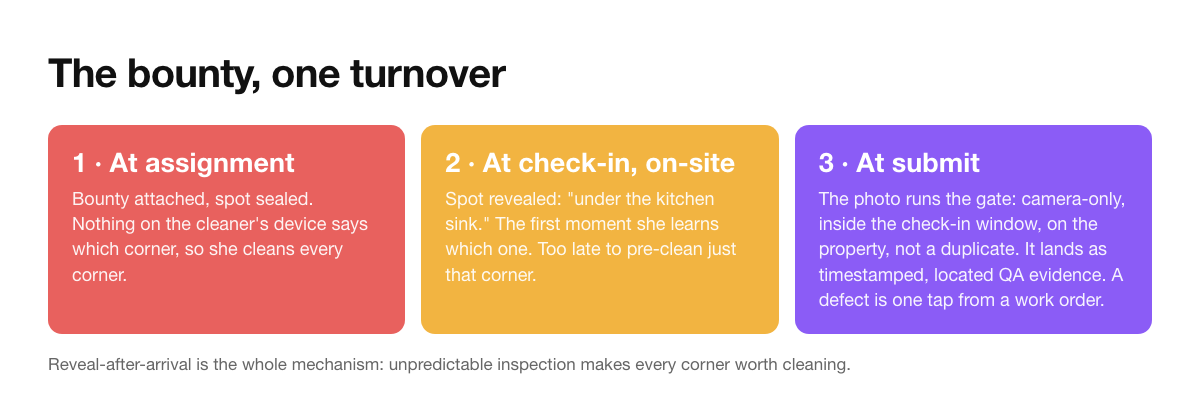
Setting it up. A few knobs, and where we’d start:
- Reveal on check-in, always. The one setting you never touch. It is the whole mechanism.
- Start on every turnover, then sample. Run it on every job at first so cleaners learn how it works. Once the behavior sticks you can drop to a random subset without losing the deterrent, because they still can’t predict which job or which corner will draw the bounty.
- Keep the bonus small and flat. A modest add-on to normal pay, sized so a big clean can’t inflate it. Predictable for you and worth the few seconds for them.
- Set a budget you’re comfortable with so you never dangle a bounty you can’t fund.
The spot list is short and preset. It’s a handful of the hidden corners a rushed clean skips: under the kitchen sink, behind the toilet, inside the oven, and the like. Several of them are exactly where a hidden defect first shows, which is why a single bounty photo can double as an early warning.
Making the photo trustworthy and honest about its limits
A photo is only evidence if it can’t be faked cheaply. The bounty is guarded at the operator level by four things: camera-only capture (the in-app camera, no gallery upload, so it’s a shot taken now, not pulled from the roll); a capture window tied to the check-in session, so the photo has to come from an actual on-site turnover; a location check on the property; and duplicate-photo detection, which kills the “resubmit last month’s photo of the same cabinet” move. The draw itself is provably random, and the selection is logged, so “was it rigged?” has a replayable answer the first time a cleaner disputes a bonus.
And then the part most tools won’t tell you:
What this is, and what it isn’t. It is randomized, dated, located proof of a spot you’d otherwise never see, on a clean you weren’t in the room for. It isn’t tamper-proof. Time and location are asserted by the device. Offline sync means the server can’t watch the shutter click. The load-bearing controls are the in-app camera and the check-in session window, not GPS. The location check deliberately degrades to flagged-for-review rather than rejecting an honest cleaner at a home you never geocoded. Treat every photo as strong evidence, but not a cryptographic guarantee.
That’s the right way to think about it operationally. The goal isn’t perfect surveillance. The goal is a reliable signal that makes the standard visible enough to reward and enforce.
"Won't my good cleaners feel spied on and quit?"
It’s the first thing every operator asks, and it’s fair. Surveillance breeds resentment, and resentful cleaners leave. The design answers it in how it’s built.
Start with what it is: a bonus on top of normal pay. It adds money to a good clean. It never docks anyone for a bad one. Your best cleaners already wipe under the sink and behind the toilet, so for them the bounty is found money for a few seconds of work. That’s a reason to like the app rather than fear it. The only people it unsettles are the ones skipping the exact corners it checks. That sorting is the outcome you wanted.
And the guardrails are tuned to protect the honest cleaner, not trap them. The location check, again, degrades to flagged-for-review rather than auto-rejecting a real cleaner standing in a home you simply never geocoded. When something is ambiguous, the system’s default is send it to a human, not punish.
The practical version of that is straightforward: explain the why, make the bonus visible, and make sure the rule is about proof of work, not micromanagement. Cleaners don’t usually mind being asked to prove a job they already did. They mind gotcha systems that assume they’re the problem.
A single turn, start to finish
Here’s a simple walkthrough of how the workflow should look in practice.
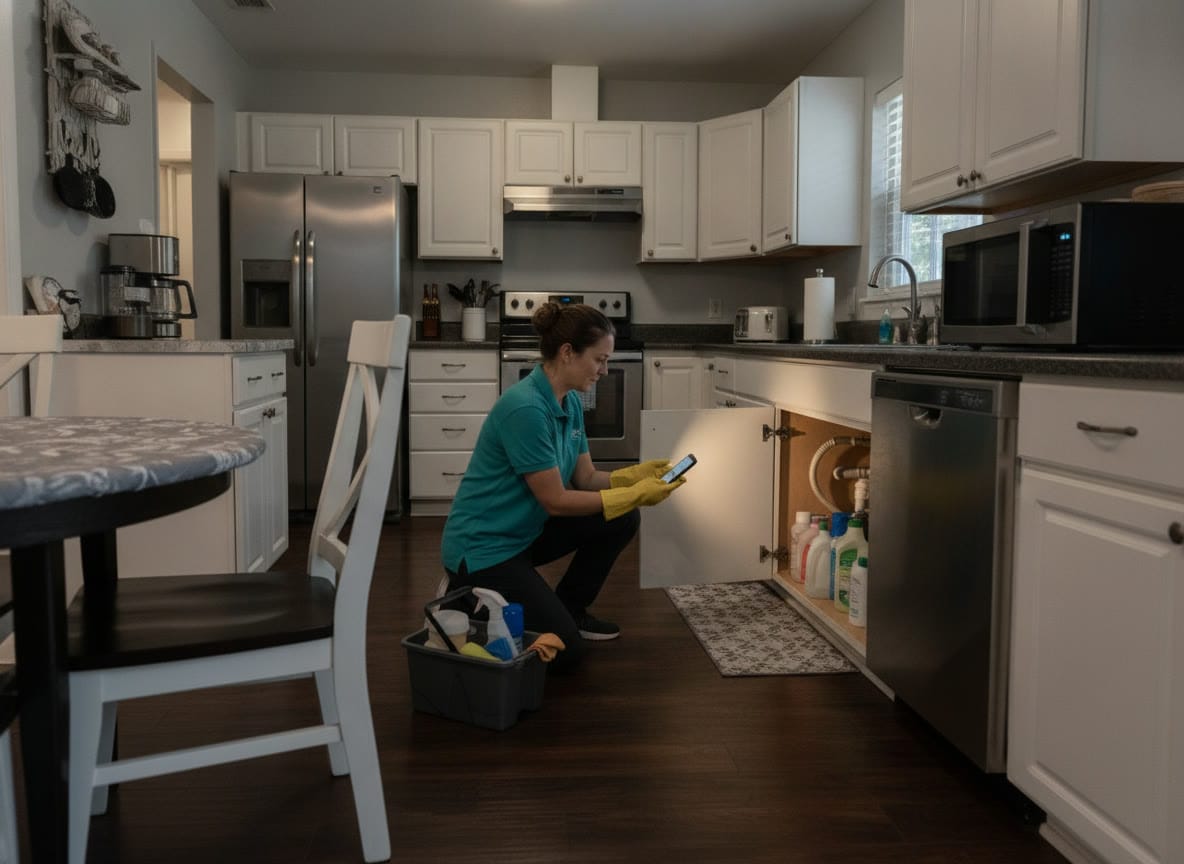
A turnover is assigned before a 4pm check-in. At assignment, the cleaner sees only that a bounty is attached: no spot, no hint. She cleans the whole unit because she has no idea which corner is coming.
She checks in on-site. The card reveals the spot: under the kitchen sink. She opens the in-app camera, takes the shot, submits. It clears the gates inside the check-in window, on the property, not a duplicate of anything on file, and lands as a timestamped, located submission for you to approve. A bonus posts to her pay.
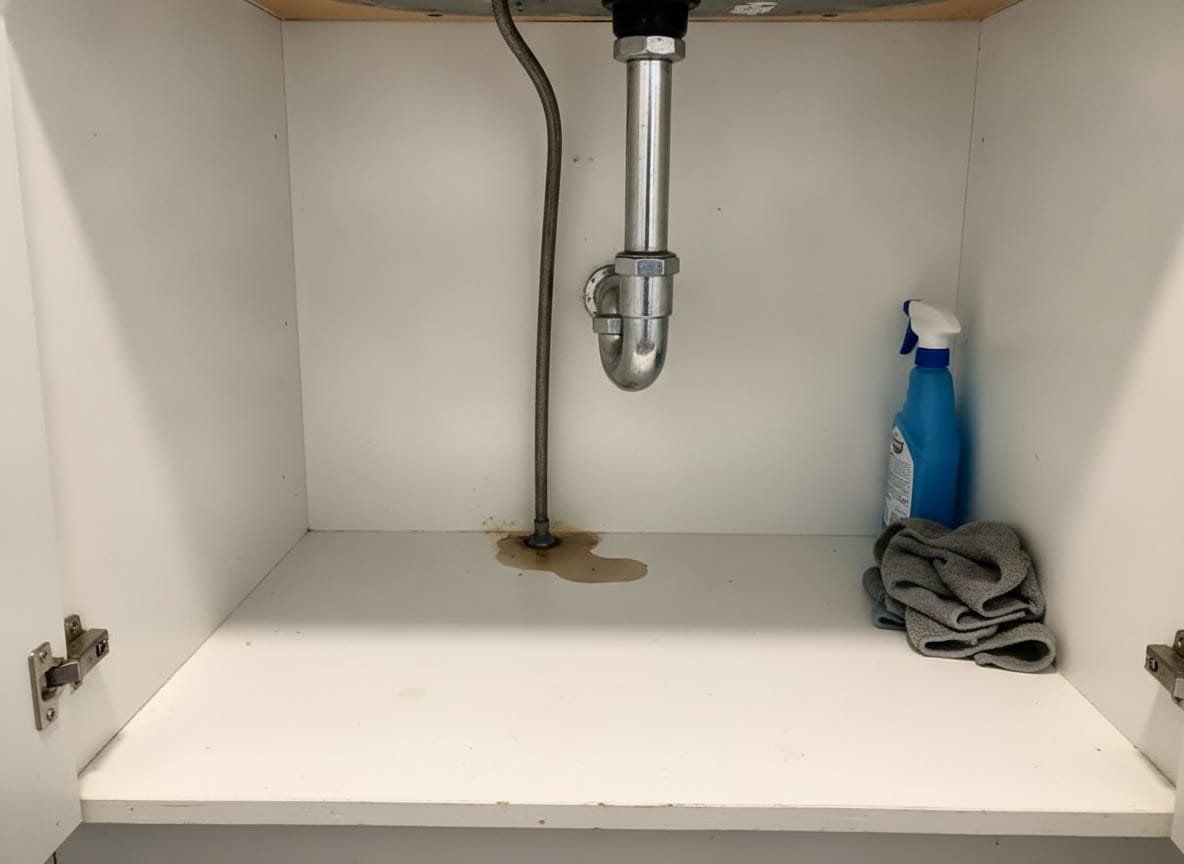
The photo shows a slow drip staining the cabinet floor. One tap turns it into a work order, image attached, before the guest ever opens the cupboard.
That’s the loop. The photos are the quality dimension your scorecard was missing: the thing that used to be felt, now a per-vendor stream you can grade retention and pay against. And because the drawn spots are the hidden trouble corners, any one of them is one tap from a work order when it reveals a leak, mold, or a pest. You get QA on cleans you never watched, plus defects caught before a guest does.
The biggest implementation pitfall is treating this like a photo task instead of a workflow change. If the reveal isn’t tied cleanly to check-in, if the bonus isn’t easy to understand, or if staff can’t tell why a submission was flagged, the system gets noisy fast. Keep the logic simple, keep the rules visible, and keep the review path human.
The one precondition, say it plainly
This works only if your cleaners check in through your app. The reveal, the capture window, and the location check all hang off that check-in event. If you run turnovers through an arms-length cleaning company that won’t put your field app in their crew’s hands, the mechanism has nothing to attach to. You’d need them on your check-in flow first. For operators whose crews already work the job card, the bounty is a flag you switch on when you’re ready.
There’s one more practical caveat worth saying out loud: this is not a replacement for good vendor management. It won’t fix bad scheduling, unrealistic turn times, or a weak escalation path. What it does is make the quality layer visible enough that those problems stop hiding behind a green “complete” status.
You can’t stand in every unit. But you can make sure your cleaner never knows which corner you’ll be looking at. That change alone is enough to get every corner cleaned like you’re already there.
The spot preset and the per-vendor quality view are part of Turnwrk Clean’s bounty program. The engineering underneath, the provably random draw, the reveal withheld at the data layer, the anti-fraud gate, is the subject of a companion build post.
Next steps
If this matches how your turnover team actually works, the next move isn’t to overhaul everything at once. Start with the smallest version of the system: pick a short preset list of hidden spots, tie the reveal to on-site check-in, and decide what you’ll pay for a verified photo. Then watch what changes in the jobs that used to produce the most complaints.
If you want the randomized-inspection playbook, the bounty setup, and the policy language we use for this, email us at hello@breezykeys.com and we will walk you through it. Prefer a form? breezykeys.com/partners reaches the same inbox.